
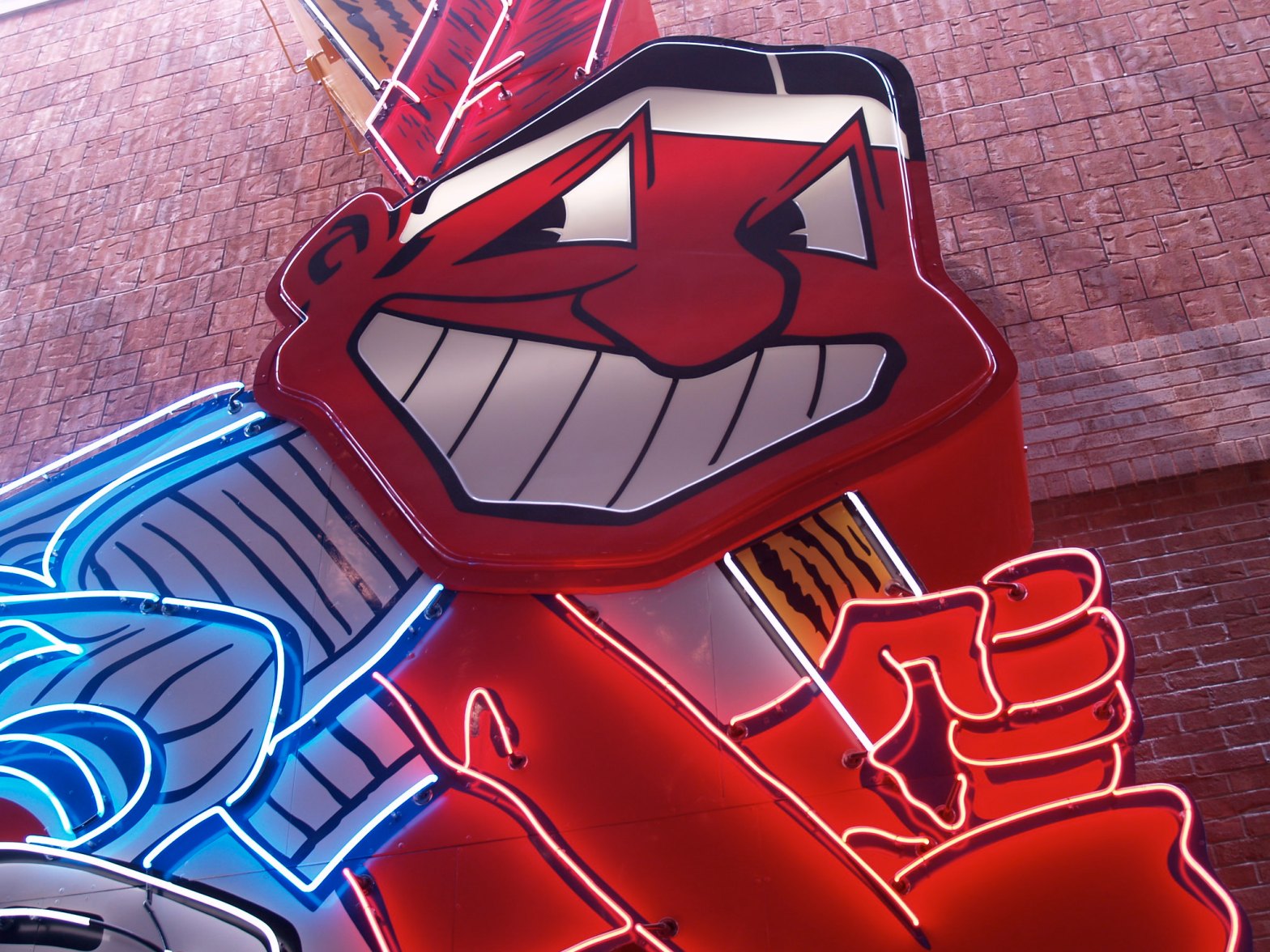
“The ‘Other’ Cleveland Team” by Imagine24
FROM THE ARCHIVES: Cleveland’s real “mistake on the lake” is an atrocious continuation of a racist logo.
Feb. 09, 2017
by Corey P. Mueller
Cuyahoga. It means “crooked river” in original Iroquoian tongue. That is the name given to both the most populous county in Ohio — home to the city of Cleveland — and the winding river that curves through the center of the county. It was a name meant to honor the indigenous people who lived off this river, the very river that the white people of Cleveland have since disrespected and polluted to the point of roaring flames in the mid-20th century.
Though the river has been cleaned up, another atrocity with a native name remains in the city. A large-nosed, red-faced, wide-grinning caricature of indigenous people still finds its home on the sleeves and ball caps of the professional baseball organization, the Cleveland Indians.
Chief Wahoo is his name, and outdated racial stereotypes are his game. Reminiscent of Tonto or any nameless antagonist to John Wayne, Chief Wahoo stares blankly into the void of white baseball fans with an ear-to-ear smile. In another attempt to “honor” those that inhabited the land before the urban area and surrounding suburbs developed, Cleveland again disrespects the names and real populations of Native Americans that exist in the United States. The continued use of stereotypes in this caricature has real world consequences. But the people of Cleveland seem not to care.
In an anonymous Twitter survey I ran, my followers (composed of mostly middle-class, suburban white people) were three and a half times more likely to vote for “#KeepTheChief” than the “Get rid of Chief Wahoo!” option. Perhaps the voters were empowered by the catchy hashtag, or they were enticed by a more sinister power given to them in perpetuating racist stereotypes with a single image. Whatever the reason, few #KeepTheChief voters came forward to explain their position.
“It’s clear that she’s never met a native, never been to a reservation. To her, natives are invisible. If they weren’t, she wouldn’t even think of wearing that.”
In fact, only one did. He was the sole voice for the majority opinion, and he said he will, in all caps, “FOREVER ROCK THE CHIEF.” When questioned with a simple “why” the 21-year-old Indians fan responded with, “It’s part of me.” Pointing to tradition and something that he grew up with, it is a sentiment that is heard over and over again within Cleveland baseball circles.
“I get it, you want to feel like you’re seven years old again going to the ballpark with your dad.” David Takehara, whose mother is full-blooded Sioux Indian, does not buy that argument. Takehara’s mother hails from the Sisseton Wahpeton Oyate tribe in South Dakota, but David grew up in Chicago. He described a recent experience watching his hometown Chicago Cubs play against the Cleveland baseball organization in the World Series. He recalls a crowd shot focusing on a young woman, a Cleveland fan. She wore a giant Chief Wahoo on her shirt, and he shook his head at the sight. “It’s clear that she’s never met a native, never been to a reservation. To her, natives are invisible. If they weren’t, she wouldn’t even think of wearing that.”
Takehara invokes the Contact Hypothesis here: The more people of color one meets, the less likely he or she is to be biased or derogatory to those people. This is a contested theory, but, according to Vincent Romero, we do know one thing: “Using this mascot perpetuates a historical, comical and insulting caricature, and it is perpetuating stereotypes that are long gone.” Romero, the Executive Director of the American Indian Center Chicago, says these stereotypes only live on because of mascots like Chief Wahoo. Native Americans are not bow-wielding, horse-riding savages, yet this is the only image many Americans have of this diverse group of people that exist off of reservations and outside of the 19th century Wild West. Yet, this is an image of which many refuse to let go.
There is not just a conflict of images here, though. There is a personal conflict that inflicts actual damage on historically damaged communities. “It’s not just about being politically correct,” Romero stated. “This gravely affects the self-esteem and pride of Native youth, and they’ll grow up becoming ashamed of their culture, of who we are.” Native kids across this country find themselves as the target of harassment, ridicule and violence when they speak up, often when they simply state, “Hey, that is racism.”
“You feel like you’re not good enough to be a regular American,” Takehara said grimly. “You’re not even visible.” Though Takehara was born and raised on the north side of Chicago, he still experienced dismissiveness of his Native roots. Teachers refused to believe he was Native American because of half the genes he inherited from his Japanese-American father.
It does not matter if your home, as a Native person, is on a reservation. Everything and everyone constantly puts you down, Takehara tells me. Using a mascot like Chief Wahoo continues a longstanding attitude of “They don’t exist, they don’t matter.”
This is just one type of historical trauma imposed upon indigenous populations of this country. Another comes at the turn of the 20th century. It was a policy of the federal government to “Kill the Indian, save the man.” Erik Stegman, the quick-talking Executive Director at the Center for Native American Youth at the Aspen Institute, expands upon this through an examination of the American Indian boarding school system. “They forcibly took kids away from their families and tribal communities, put them in boarding schools where they were beaten for speaking their language. They were forced to assimilate, and they were horrible places.” Native youth in the past, like Takehara’s mother, have been traumatized at these types of places with physical and mental abuse.
Some of these abuses, for example, come in the form of caricatures and stereotypes of what not to be. During her stay at an American Indian boarding school, Takehara’s mother was taught and tortured to be ashamed of her culture and heritage. There is an intergenerational trauma that cycles through this: Where parents and grandparents in the past were shown racist imagery to shame them for their history, youth today are bullied, targeted and again stripped of their culture through ahistorical representations of mascots in schools and in professional sports.
“Mascots become a reference point for bullying,” Stegman explained. “They’re a tool for abuse, especially when non-Native people use them.” This creates a hostile learning environment that contributes to mental health issues, creating a large hurdle for progress in Native communities. Natives commit suicide nearly two and a half times the national average rate, which makes suicide the second leading cause of death for Natives between the ages of 15 and 35.
A mental health crisis, paired with a poverty rate double that of the national average, plagues Native populations. And the continued use of a Chief Wahoo shows that non-Native people do not really care all that much. Further, they still demand that the Native people bootstrap their way out of it. “It makes it tough to do what people ask you to do,” Takehara said with an inkling of pain in the back of his throat. “Reservations have less jobs, less opportunities. But how do you get out of that if you have a reduced self-esteem?” Though some may scoff at the idea of this, decreased self-esteem drastically and negatively impacts people’s performances in and out of the classroom. It sets them up to fail before they can even try to succeed.
To start to combat this antagonistic imposition, MLB organizations need to denounce and eliminate the use of mascots like Chief Wahoo, as painful as that may be to the white fan base in Cleveland. Overwhelmingly, the response from the Native communities has been that the organization must discontinue the mascot and disavow its use as a culturally insensitive and stereotypical abomination. Chief Wahoo’s discontinuation would send a powerful message that the Cleveland baseball organization is starting to listen, but that is only a start. “They have to have an open, honest dialogue with local and national native groups,” Romero iterated and reiterated to me, with more pressing concern on each utterance of this important sentiment. “The leadership in the front office needs to set an example for the rest.”
Ultimately, the team needs to make sure the concerns of Native peoples and activists are heard and that they respectfully engage with this issue. Currently, the organization releases shrouded statements that the team will “phase out” the use of the Chief, yet continue to use him on nearly all of their jerseys.
One of the worst defenses of the use of a mascot like Wahoo, according to Stegman, is people claiming that they are “somehow honoring native people,” without respectfully appreciating the culture and acknowledging the history of Native peoples in this country. “When you can’t even point to what supposed tribe this representation is from,” Stegman briefly laughs at the absurdity of his own thought, “how exactly can a non-native person say that they’re honoring anything?”
 Corey P. Mueller