
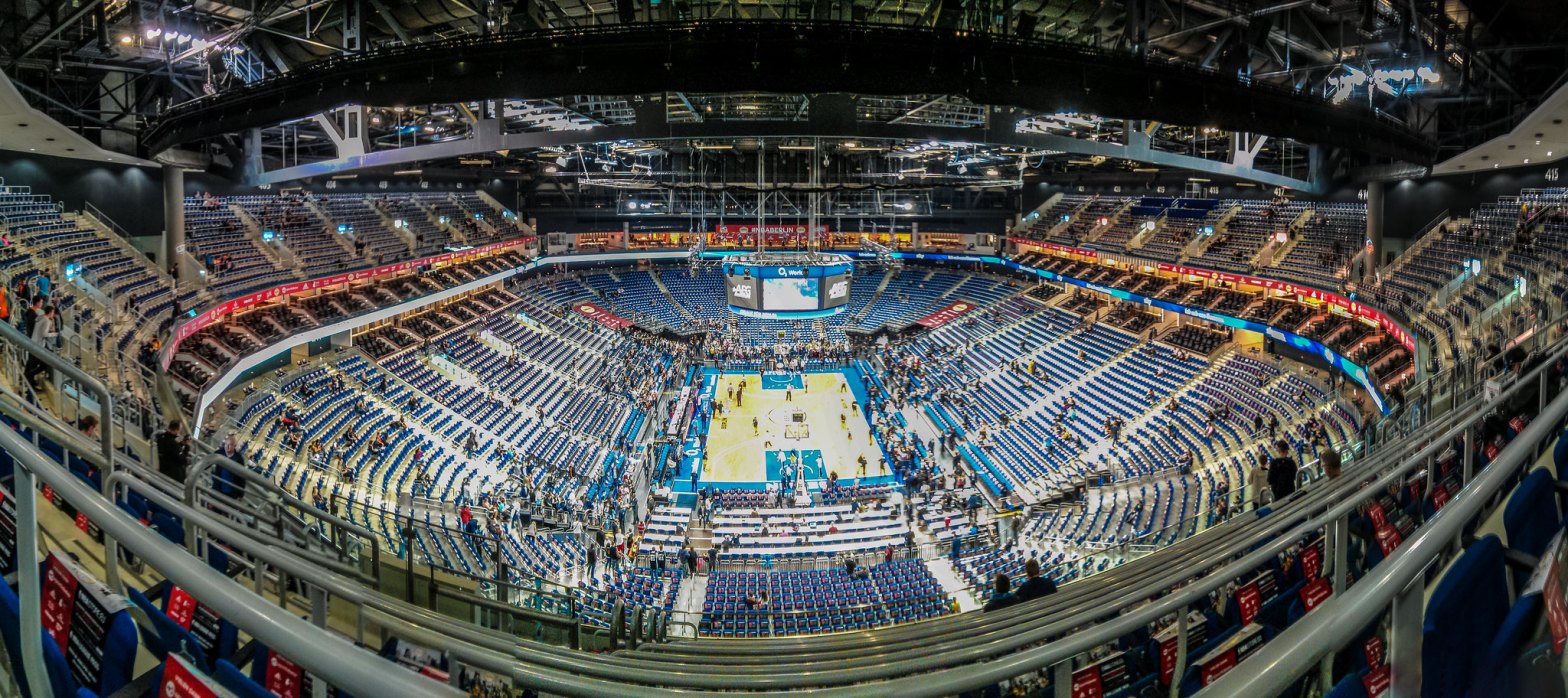
“Robert Emmerich – 2 PAN O2 World with NBA vs. Alba Berlin – Germany” by Robert Emmerich Photography
The NBA, the coronavirus, and the decisions made along the way.
Dec. 30, 2020
by Corey P. Mueller
The NBA is back!
Normally, this would be cause for celebration in my household – I have a running fantasy basketball league in its 11th season, which is a constant source of trash-talking and sideline-analyzing for my brothers, my dad and me. The National Basketball Association is one of the threads that connects us, and draft night is essentially a holiday for us. It has its own traditions: my younger brother showing up right at draft time, my dad saying “aw, I was gonna take him!” once every three rounds and my older brother’s end-of-night Excel report.
I cannot celebrate the return of my favorite league this year, however (yes, I know, I’m an adult and this sounds ridiculous, but I love basketball like the player-formerly-known-as Metta World Peace loves basketball). COVID-19 has made many things miserable; it has caused too many deaths and a nosedive in the economy, and its ever-present anxiety inducement and frustration and risk and damage does not magically stop at the doors of NBA arenas. The NBA’s decision to start a new season amid the newest peak of the American pandemic is bewildering at my most generous read, and it is actively harmful at worst.
The NBA was the pioneer of American sports leagues in the pandemic; the NBA established a “bubble” with 22 of its 30 teams participating in an isolated league on Disney’s Orlando campus. Teams stayed in one of three designated hotels, played eight regular season games and a full set of playoff series.
These choices were made in a pinch – the NBA postponed its regular season on the night of March 11th but had approved a plan to restart the season by June 5th. That is 86 days. There were monetary incentives to complete the season, but the NBA buckled down and created a set of health and safety protocols in fewer than three months that would lead to the best example of “Stop the Spread” this country has seen. There was testing, there was testing, and there was testing. There were isolation protocols in case a player tested positive. There were limitations on visitors and travel; there were no guests allowed until the playoffs, and the league mandated a 10-day quarantine for players who left without its approval, or 4-day quarantine with league approval *and* a negative test every day that player was outside of the bubble. The NBA had set its course as the country was rapidly changing and shutting down.
On March 11th, I was sitting at a desk inside 30 Rockefeller Center, following the stats of the night on my phone while finishing a shift inside that 66-floor building. Tom Hanks tested positive for COVID-19 and started a quarantine over in Australia, but the virus didn’t feel *here* yet. When Rudy Gobert tested positive that same day, an entire sports league came to a screeching halt. A man who playfully touched a bunch of reporter microphones became patient zero in the NBA, and I remember thinking “oh, this is real now, and this is here.” Rudy Gobert’s downplaying of and subsequent contraction of the coronavirus had been a warning sign, and the NBA heeded!
The NBA, however, has scrapped its previous framework and gone back to a relative normal, save crowd sizes. The league had zero (0!) positive cases inside the bubble after players had settled in on campus. This time around, the league reported on December 2nd that 48 NBA players tested positive for COVID-19 during the first week of league testing for the 2020-21 season. I will concede that more teams are participating in this season than in the bubble, which leads to a greater probability that some players or staff would have contracted the virus.
What makes the start of this new season particularly frustrating is that National Basketball Players Association Executive Director Michele Roberts said the following in a late-July ESPN interview:
“If tomorrow looks like today, I don’t know how we say we can do it differently,” Roberts told ESPN in a phone interview Tuesday afternoon. “If tomorrow looks like today, and today we all acknowledge — and this is not Michele talking, this is the league, together with the PA and our respective experts saying, ‘This is the way to do it’ — then that’s going to have to be the way to do it.”
Has the coronavirus pandemic gotten better since that date? According to the NBA’s actions, it would suggest that it has. On July 22nd, the first day of exhibition games in the restart, there were 1,094 coronavirus deaths reported in the United States. This was part of the upward trend of coronavirus cases and daily deaths during the summer, which plateaued through August and into mid-September.
In the “tomorrow” land – specifically on December 23rd – the United States sets a single-day record with 3,350 reported deaths, according to NBC News. That same day, the Houston Rockets were unable to field a team and they postponed their first game of the new season. League rules state that a team needs 8 of its 15 rostered players in order to compete. The Rockets did not meet this requirement. Adam Silver’s lining is that his league has handled it relatively well compared to other leagues. The cruel reality is that 21-year-old Keyontae Johnson, a Division I NCAA athlete, collapsed on an American basketball court on December 12th. Johnson was hospitalized and briefly put into a medically induced coma. Afterwards, Johnson was diagnosed with acute myocarditis, which is a known cause of death in COVID-19 patients, just months after testing positive for the novel coronavirus. Keyontae Johnson survived but will not return to playing basketball this year. Johnson’s teammates continued and finished the game despite him being carried off in a stretcher, unresponsive to the first responders.
Other athletes have had to step in due to coronavirus-related absences, too. The Denver Broncos had to call on a practice team wide receiver when all four of its quarterbacks were out due to positive coronavirus cases and the NFL’s precautionary safety measures. The Baltimore Ravens had 22 players (over 40% of its roster!) out with the COVID-19 injury reserve designation, but still played 6 days after their originally scheduled game. There seems to be little concern with preventing the spread of the coronavirus until it’s too late.
The sports world is not alone in its struggle with this disease; the United States is failing to contain this novel disease that has taken at least 332,000 American lives at the time of writing this. The United States purports to be the world’s wealthiest and one of its most innovative country, and the US even ranks fourth in the World Index of Healthcare Innovation.
Yet, the United States continues to fail, seemingly never learning from the good or the bad measures taken either in the professional leagues or the communities in which we live.
In Roberts’ “tomorrow,” things have gotten much, much worse! Mind-bendingly, the NBPA only released a 57-word statement on November 6 approving a 72-game season and a start date of December 22, 2020. The teams would travel to their opponent’s respective cities, with Toronto as the only exception, and play a “regular” regular season. I can understand the hesitancy for adults with families (or young adults who would like to live their young, professional-athlete lifestyle!) to be locked away in isolation for an entire season, but the NBPA had nothing but rumors as to why they didn’t want a bubble. The league started much before the suggested dates in this Los Angeles Times article, which has NBA commissioner Adam Silver that he believed the 2021 season would start sometime in January of this year.
I understand a new bubble could be a logistical nightmare for the league – do we expand to two bubbles? Does that mean one is an Eastern Conference bubble in Orlando again and another Western Conference bubble is held in, I don’t know, Los Angeles or Chicago? They would need a minimum of three legitimate arenas, as demonstrated by the NBA’s first go of it, plus proper housing for these athletes and staff. These are logistics that the NBA figured out once.
The NBA, instead, abandoned its tried-and-true bubble method in lieu of a traveling, full season. James Harden is partying with his friends. John Wall is not the only one getting a haircut in this country, but he is one of the privileged few with access to rapid testing, contact tracing and proper quarantining resources. I don’t blame these individuals for doing these things – some are clearly irresponsible actions that I will not defend, but there are larger systems at play, too.
The NBA has done it right, they have the resources to do it, but they refuse to. This, I believe, is the core issue I take with the league. The NBA serves as an example of dangerous complacency. They could be showing us, again, this is how things *should* be done. Instead, they ask us to soothe ourselves with sports as entertainment, ignoring the all-too-real human cost. The NBA’s lack of regard for public health and safety is the same indifference and recklessness that has allowed this plague to spread unabated for the better part of a year.
I am incredibly disappointed in how the United States has handled the pandemic response, and basketball was a source of reprieve, especially in its response the first time around. I was holding out hope that the NBA could be the last beacon of light in this dark year. Yet, like all the Instagram stories of folks at weddings and parties and bars – and some eventual positive COVID test results – it has deteriorated my faith our ability to get through this without continuing the trend of excess, unnecessary suffering and death. I wanted the NBA to follow its own framework because, from a public health standpoint, they were nearly pristine! A few players broke protocol and were lucky to not test positive in the bubble, but the league kept its players, coaches and staff coronavirus-free from mid-July into mid-October. Unprecedented in this country.
The NBA is shirking its responsibility to its own players, coaches, and staff with its decision to carry out a dangerous, if lucrative, “regular” season. Recent broken protocol led to an opening-night cancellation for the Houston Rockets and Oklahoma City Thunder. Four Rockets will miss seven (7) days due to their isolation as a result of coronavirus contract tracing. Regardless, we got Christmas Day games! What the NBA is doing is putting a band-aid on the hull of a ship after a cannonball has ripped its way through, and, all the while, telling us to ignore that more cannonballs are coming.
The country is still in trouble, and the league is no different. It’s too late, and the wheel will continue to grind, but it is truly a shame that this is the version of basketball and society we get going into the new year.
I was hopeful the past year would bring about the right lessons, but it seems America (and the very American Basketball league, it turns out) refuses to learn.
Three-hundred thirty thousand Americans are dead, but 3,000 screaming fans will cheer on the Rockets at their next home game, blissfully insulated from the overflowing ICUs across the country, filled with people who would also, without a doubt, love to pretend that everything’s okay.
 Corey P. Mueller