
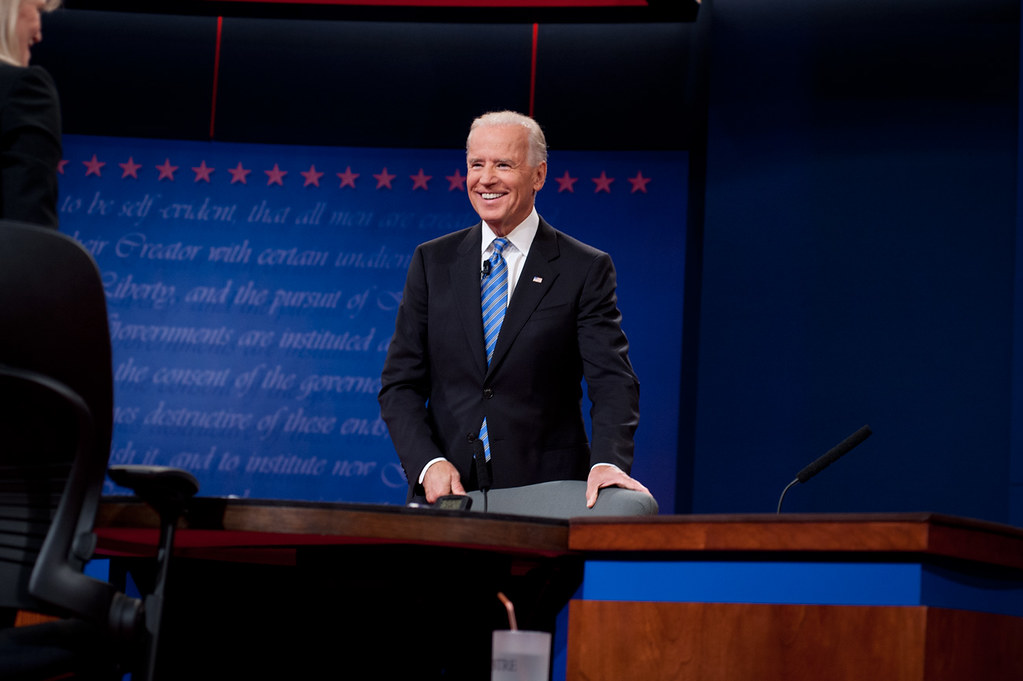
Joe Biden—Vice presidential debate 2012. Photo by: Christopher Dilts for Obama for America
How the forever campaign for presidency warps politics in the United States.
Jan. 20, 2021
by Corey P. Mueller
Today is the first day of Joe Biden’s presidency, day one of a presumed 1461 days in office. Some Democrats are breathing a sigh of relief while others are readying up for the continued fight to push the new president left, and the Republicans are already declaring the new administration a failure. The combative nature of politics will not change overnight, no matter how many calls for unity ring out or claims of restoring the soul of the nation fall upon our ears.
What can change, however, is how we view the President’s office and how we can better contribute to the politics of this country. Currently, the media bolsters careers of the media-savvy politicians who engage in seemingly endless campaigns for the highest office in the land. This is a mistake and unnecessarily overemphasizes individual actors within the larger political system while undermining issues facing the American people. We may know what Sen. Tom Cotton thinks, thanks to an ill-advised New York Times column about unleashing military force on anti-police brutality protesters, but we fail to properly hash out police reform and budgetary questions raised by the Black Lives Matter movement. It is not Sen. Cotton’s fault that questions surrounding “Defund the Police” arose, but it is a problem the Arkansas senator can capitalize on these news cycles and create a buzz for his personal political advancement while only facing Twitter backlash and a semi-embarrassing Editor’s Note in the New York Times. It feels strange to lambast someone for pursuing a career ambitiously, but politicians have an additional responsibility in their public service and thus must face a more critical lens on their actions.
Politicians have always been public figures and publicly revered or reviled by constituents, but the way Americans consume political media has also changed how the public engages with politics. Gone are the days of holding meetings with Mr. Mayor in a local church and asking him about some local issue; instead, slacktivists now retweet Jimmy Dore’s uninformed attacks on left-leaning congresspeople as part of a perceived “engagement” with politics. I do not want to downplay the actual organization that occurs online and theory education that spreads more rapidly thanks to a more connected internet, however a lot of folks retweet messages and perceive themselves as “doing the work.” This is deceiving, though, and is removed from being part of an involved electorate or advocacy group. It does not properly understand how politics operates as a mechanism of power nor how that power is wielded to make changes in our society. In a conversation with Chris Hayes, Tufts University professor Eitan Hersh explains the dangers this phenomenon, which he calls “political hobbyism:”
“In terms of organizational involvement, having people attend a meeting, belong to a group, do political or civic work with churches, that’s been on the decline for years.
We’re below historical averages in terms of organizational engagement in politics or civics, attending community meetings, parent-teacher things, that kind of thing. We’re at an all-time high in terms of cognitive engagement in politics. So we’re definitely at an all-time high in terms of the number of people who say politics is important, who say they care about politics and it’s kind of weird, right? Because that number has gone way up, particularly in the Trump era, particularly for liberals. But the organizational metrics have not quite gone up in the same way.”
Hersh and Hayes dive more deeply into how one can be more civically engaged in their conversation (and it is very much worth a listen if you consider yourself a “political junkie”), but I want to put that discussion aside and apply some of the lessons to political media. Hersh establishes that we have a higher “cognitive engagement” with politics nowadays (more people read or scroll Twitter and Facebook or watch TV news), but it is, “engaging in news consumption, in partisan cheerleading, in online activism, [and] online amateur punditry.” The media needs to take some responsibility for how that has happened and how that affects the on-the-ground politics of the nation. In responding to this demand for bite-size, consumable “politics,” the media misses the mark and frames politics more as infotainment instead of Hersh’s idea of politics for power and real, tangible change. In doing so, the media incentivizes and rewards people like Sen. Tom Cotton, Sen. Josh Hawley, and Gov. Andrew Cuomo for their media presence in lieu of their actions within their branches of our political system. It creates celebrities out of politicians that feeds into unhealthy hero worship with these figures; Senator Josh Hawley was floated as a potential 2024 candidate in January 2020 and Gov. Andrew Cuomo was leading the field of potential 2024 Democrat candidates in August, 2020. Washington Post politics reporter Dave Weigel’s ongoing “(s)he’s running” Twitter joke succinctly captures that politicians and public figures understand they must have a positive media personality and public image in order to reach higher office.
Both men, Hawley and Cuomo, understand a key part of how political showmanship influences their chances at a presidential run, but we should not ignore or mislead the public to believe that these high-profile politicians would be impressive or good leaders. Sen. Josh Hawley has rightfully earned backlash after holding up a power fist to a pro-Trump mob a few hours before those rioters broke into the capitol in hopes of stopping an election process to certify Joe Biden as the 46th president of the United States. Hawley’s response to his actions and accusations of inciting a riot was to stare directly into the C-SPAN camera after the Senate reconvened. Sen. Hawley understands that, to rehabilitate or combat criticism, he needed not address his colleagues (you know, the other public servants who supposedly work to provide policies and aid to this country and improve the lives of the public). Instead, he was working the cameras like he’s worked Twitter and addressed those on the other side of the screen. Hawley is savvy, he stirred up some controversy with the NBA when he sent a letter to the league that decried the NBA for allowing players to wear social justice messages on their jerseys during the NBA Bubble season. ESPN reporter Adrian Wojnarowski got suspended for responding to Hawley’s email simply and succinctly: “F— you Sent from my iPhone.” Wojnarowski gave Hawley the response that the senator was looking for, it was an excuse for Hawley voice some cultural aggrievement about China and stirred up controversy that put Sen. Hawley in a national spotlight. Hawley contributed nothing to actual politics with this PR stunt, but he bolstered his own profile as the center of that news cycle. He tried to introduce a bipartisan amendment with Sen. Bernie Sanders to distribute $1200 stimulus checks to Americans in December 2020, but that amendment eventually failed, and Hawley was unable to deliver any meaningful aid to the public. Sen. Hawley got his name attached to all the good press, though, and he understands the value of name recognition. FiveThirtyEight notes that, in primaries, there is a big advantage for candidates who are a household name:
“A candidate’s adjusted polling average — polling average divided by name recognition, which we delved into at length in the first two parts of this series — is a decent proxy for teasing out the strength of a candidate, especially early in the election cycle. By accounting for how well known a candidate is, we can get a better read on the field in front of us.”
Gov. Andrew Cuomo got his own share of empty positive press in the last year, too. After moving to Cleveland from New York after April of 2020, I got so frustrated explaining to people back home why Andrew Cuomo was not *really* doing that great of a job with the pandemic. I attribute Cuomo’s rise in popularity to his interviews with his brother, Chris Cuomo, on CNN and their objectional interviews. In journalism classes in college, I was told that if I would invite someone to my birthday party, they should not be my source for a story. That close, personal relationship erodes the integrity of the story – the interviewer will not be as steadfast in asking truth-seeking questions and their relationship with the source overrides the interviewer’s journalistic code of ethics. It is important to build a rapport and maintain relationships with sources, of course, but playfully arguing who should call their mother and signing off with “I love you, brother,” crosses a line that invokes emotional responses not appropriate for those moments. It is unabashed positive PR for Gov. Andrew Cuomo when the proper interview would question why his response to the coronavirus was so delayed and why he failed to contain the virus in his state. Cuomo has also proven, with his recent abysmal handling of vaccine rollout (bogging down the rollout so much that they literally had to throw out unused vaccines!), that he is just as inept as most of the country’s leaders when it comes to properly combatting COVID-19. Gov. Andrew Cuomo has a pleasant voice on his media conference calls (when he isn’t yelling at reporters for asking questions to clarify what is happening) and jokes around with his brother on national television, but it does not absolve him of being incompetent as a leader in the face of a disease that has killed 40,000 people in his state. His media appearances should not launder his reputation, and the media has a responsibility to highlight the objective failures of this man. Gov. Cuomo is qualified to be the 2024 Democratic presidential candidate only if the criterion to be so is “can you playfully joke with your brother on national television” (there are other metrics, though, beyond personality and an elevated media profile that qualify a person for the presidency).
National news outlets are more accessible to the public with the growth of the internet and television access (the New York Times topped 6 million subscribers and digital subscribers boomed during the pandemic). Television accounts for a significant portion of the population’s news consumption. According to Pew Research Center, 68 percent of U.S. adults get their news either “Often” (40%) or “Sometimes” (28%) from television, but CNN and MSNBC and Fox News are covering national politics. With this comes some responsibility to properly frame and cover national topics, but these networks overwhelmingly contribute to the profile-building and ongoing political campaigning of politicians.
Bill Scher of Politico posits that political pundits “ignore the cries of ‘TOO SOON!’ when [they] start talking about the next presidential election […] for good reason: The prospective candidates are already looking ahead, and we should, too.” An easy counterargument is “no, we shouldn’t, nor should they.” But we should not do this for the incentive structure that this creates in national politics; the Politco article (named “Which 2024 Candidates Won 2020?”) was published on December 28, 2020 and started analyzing the next election and its candidates before the 2020 presidential winner had even been sworn in! It is incredibly irresponsible to frame politics as never-ending races and misunderstands the urgency and seriousness with which politics need to be covered now. I do not want to read too deeply into it, but articles such as this positively reinforce the wrong things – it encourages candidates to be media savvy over politically savvy, popular over prepared, and a celebrity over a qualified and competent leader.
Donald J. Trump was not the first celebrity president – I remember being told in high school that the Iran hostage crisis ended on the first day of Ronald Reagan’s presidency because they feared that cowboy they had seen in the pictures – but Trump continued campaign rallies almost immediately after winning the 2016 election. There was a feeling of a “forever campaign,” but that must be left that behind. If we stop considering politicians as primary candidates and truthfully engage with their actions, we will take the right steps towards positive and meaningful political engagement. Their political aspirations are not the media’s responsibility, nor is it responsible journalism/news consumption to continue to frame politics with only the next election in mind. End the popularity contests; focus on the people and the political solutions to problems of today.



 Corey P. Mueller