THE NEVERENDING PRIMARY

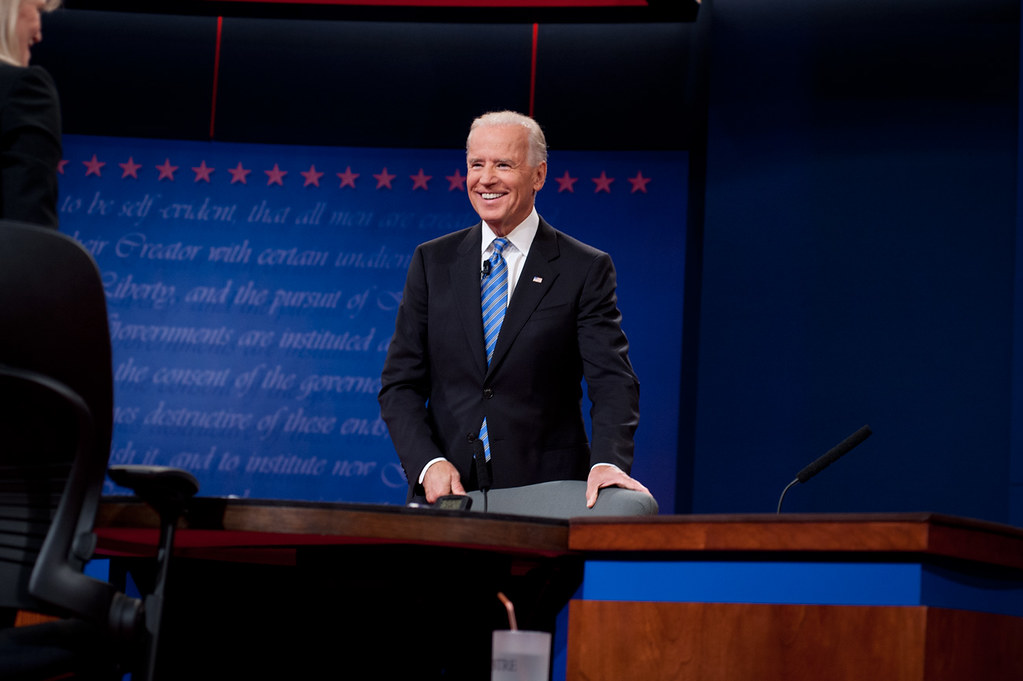
Joe Biden—Vice presidential debate 2012. Photo by: Christopher Dilts for Obama for America

How the forever campaign for presidency warps politics in the United States.

Jan. 20, 2021
by Corey P. Mueller

Today is the first day of Joe Biden’s presidency, day one of a presumed 1461 days in office. Some Democrats are breathing a sigh of relief while others are readying up for the continued fight to push the new president left, and the Republicans are already declaring the new administration a failure. The combative nature of politics will not change overnight, no matter how many calls for unity ring out or claims of restoring the soul of the nation fall upon our ears.

What can change, however, is how we view the President’s office and how we can better contribute to the politics of this country. Currently, the media bolsters careers of the media-savvy politicians who engage in seemingly endless campaigns for the highest office in the land. This is a mistake and unnecessarily overemphasizes individual actors within the larger political system while undermining issues facing the American people. We may know what Sen. Tom Cotton thinks, thanks to an ill-advised New York Times column about unleashing military force on anti-police brutality protesters, but we fail to properly hash out police reform and budgetary questions raised by the Black Lives Matter movement. It is not Sen. Cotton’s fault that questions surrounding “Defund the Police” arose, but it is a problem the Arkansas senator can capitalize on these news cycles and create a buzz for his personal political advancement while only facing Twitter backlash and a semi-embarrassing Editor’s Note in the New York Times. It feels strange to lambast someone for pursuing a career ambitiously, but politicians have an additional responsibility in their public service and thus must face a more critical lens on their actions.

Politicians have always been public figures and publicly revered or reviled by constituents, but the way Americans consume political media has also changed how the public engages with politics. Gone are the days of holding meetings with Mr. Mayor in a local church and asking him about some local issue; instead, slacktivists now retweet Jimmy Dore’s uninformed attacks on left-leaning congresspeople as part of a perceived “engagement” with politics. I do not want to downplay the actual organization that occurs online and theory education that spreads more rapidly thanks to a more connected internet, however a lot of folks retweet messages and perceive themselves as “doing the work.” This is deceiving, though, and is removed from being part of an involved electorate or advocacy group. It does not properly understand how politics operates as a mechanism of power nor how that power is wielded to make changes in our society.  In a conversation with Chris Hayes, Tufts University professor Eitan Hersh explains the dangers this phenomenon, which he calls “political hobbyism:”

“In terms of organizational involvement, having people attend a meeting, belong to a group, do political or civic work with churches, that’s been on the decline for years.

We’re below historical averages in terms of organizational engagement in politics or civics, attending community meetings, parent-teacher things, that kind of thing. We’re at an all-time high in terms of cognitive engagement in politics. So we’re definitely at an all-time high in terms of the number of people who say politics is important, who say they care about politics and it’s kind of weird, right? Because that number has gone way up, particularly in the Trump era, particularly for liberals. But the organizational metrics have not quite gone up in the same way.”

Hersh and Hayes dive more deeply into how one can be more civically engaged in their conversation (and it is very much worth a listen if you consider yourself a “political junkie”), but I want to put that discussion aside and apply some of the lessons to political media. Hersh establishes that we have a higher “cognitive engagement” with politics nowadays (more people read or scroll Twitter and Facebook or watch TV news), but it is, “engaging in news consumption, in partisan cheerleading, in online activism, [and] online amateur punditry.” The media needs to take some responsibility for how that has happened and how that affects the on-the-ground politics of the nation. In responding to this demand for bite-size, consumable “politics,” the media misses the mark and frames politics more as infotainment instead of Hersh’s idea of politics for power and real, tangible change. In doing so, the media incentivizes and rewards people like Sen. Tom Cotton, Sen. Josh Hawley, and Gov. Andrew Cuomo for their media presence in lieu of their actions within their branches of our political system. It creates celebrities out of politicians that feeds into unhealthy hero worship with these figures; Senator Josh Hawley was floated as a potential 2024 candidate in January 2020 and Gov. Andrew Cuomo was leading the field of potential 2024 Democrat candidates in August, 2020. Washington Post politics reporter Dave Weigel’s ongoing “(s)he’s running” Twitter joke succinctly captures that politicians and public figures understand they must have a positive media personality and public image in order to reach higher office.

Both men, Hawley and Cuomo, understand a key part of how political showmanship influences their chances at a presidential run, but we should not ignore or mislead the public to believe that these high-profile politicians would be impressive or good leaders.  Sen. Josh Hawley has rightfully earned backlash after holding up a power fist to a pro-Trump mob a few hours before those rioters broke into the capitol in hopes of stopping an election process to certify Joe Biden as the 46th president of the United States. Hawley’s response to his actions and accusations of inciting a riot was to stare directly into the C-SPAN camera after the Senate reconvened. Sen. Hawley understands that, to rehabilitate or combat criticism, he needed not address his colleagues (you know, the other public servants who supposedly work to provide policies and aid to this country and improve the lives of the public). Instead, he was working the cameras like he’s worked Twitter and addressed those on the other side of the screen. Hawley is savvy, he stirred up some controversy with the NBA when he sent a letter to the league that decried the NBA for allowing players to wear social justice messages on their jerseys during the NBA Bubble season. ESPN reporter Adrian Wojnarowski got suspended for responding to Hawley’s email simply and succinctly: “F— you     Sent from my iPhone.” Wojnarowski gave Hawley the response that the senator was looking for, it was an excuse for Hawley voice some cultural aggrievement about China and stirred up controversy that put Sen. Hawley in a national spotlight. Hawley contributed nothing to actual politics with this PR stunt, but he bolstered his own profile as the center of that news cycle. He tried to introduce a bipartisan amendment with Sen. Bernie Sanders to distribute $1200 stimulus checks to Americans in December 2020, but that amendment eventually failed, and Hawley was unable to deliver any meaningful aid to the public. Sen. Hawley got his name attached to all the good press, though, and he understands the value of name recognition. FiveThirtyEight notes that, in primaries, there is a big advantage for candidates who are a household name:

“A candidate’s adjusted polling average — polling average divided by name recognition, which we delved into at length in the first two parts of this series — is a decent proxy for teasing out the strength of a candidate, especially early in the election cycle. By accounting for how well known a candidate is, we can get a better read on the field in front of us.”

Gov. Andrew Cuomo got his own share of empty positive press in the last year, too. After moving to Cleveland from New York after April of 2020, I got so frustrated explaining to people back home why Andrew Cuomo was not *really* doing that great of a job with the pandemic. I attribute Cuomo’s rise in popularity to his interviews with his brother, Chris Cuomo, on CNN and their objectional interviews. In journalism classes in college, I was told that if I would invite someone to my birthday party, they should not be my source for a story. That close, personal relationship erodes the integrity of the story – the interviewer will not be as steadfast in asking truth-seeking questions and their relationship with the source overrides the interviewer’s journalistic code of ethics. It is important to build a rapport and maintain relationships with sources, of course, but playfully arguing who should call their mother and signing off with “I love you, brother,” crosses a line that invokes emotional responses not appropriate for those moments. It is unabashed positive PR for Gov. Andrew Cuomo when the proper interview would question why his response to the coronavirus was so delayed and why he failed to contain the virus in his state. Cuomo has also proven, with his recent abysmal handling of vaccine rollout (bogging down the rollout so much that they literally had to throw out unused vaccines!), that he is just as inept as most of the country’s leaders when it comes to properly combatting COVID-19. Gov. Andrew Cuomo has a pleasant voice on his media conference calls (when he isn’t yelling at reporters for asking questions to clarify what is happening) and jokes around with his brother on national television, but it does not absolve him of being incompetent as a leader in the face of a disease that has killed 40,000 people in his state. His media appearances should not launder his reputation, and the media has a responsibility to highlight the objective failures of this man. Gov. Cuomo is qualified to be the 2024 Democratic presidential candidate only if the criterion to be so is “can you playfully joke with your brother on national television” (there are other metrics, though, beyond personality and an elevated media profile that qualify a person for the presidency).

National news outlets are more accessible to the public with the growth of the internet and television access (the New York Times topped 6 million subscribers and digital subscribers boomed during the pandemic). Television accounts for a significant portion of the population’s news consumption. According to Pew Research Center, 68 percent of U.S. adults get their news either “Often” (40%) or “Sometimes” (28%) from television, but CNN and MSNBC and Fox News are covering national politics. With this comes some responsibility to properly frame and cover national topics, but these networks overwhelmingly contribute to the profile-building and ongoing political campaigning of politicians.  

Bill Scher of Politico posits that political pundits “ignore the cries of ‘TOO SOON!’ when [they] start talking about the next presidential election […] for good reason: The prospective candidates are already looking ahead, and we should, too.” An easy counterargument is “no, we shouldn’t, nor should they.” But we should not do this for the incentive structure that this creates in national politics; the Politco article (named “Which 2024 Candidates Won 2020?”) was published on December 28, 2020 and started analyzing the next election and its candidates before the 2020 presidential winner had even been sworn in! It is incredibly irresponsible to frame politics as never-ending races and misunderstands the urgency and seriousness with which politics need to be covered now. I do not want to read too deeply into it, but articles such as this positively reinforce the wrong things – it encourages candidates to be media savvy over politically savvy, popular over prepared, and a celebrity over a qualified and competent leader.

Donald J. Trump was not the first celebrity president – I remember being told in high school that the Iran hostage crisis ended on the first day of Ronald Reagan’s presidency because they feared that cowboy they had seen in the pictures – but Trump continued campaign rallies almost immediately after winning the 2016 election. There was a feeling of a “forever campaign,” but that must be left that behind. If we stop considering politicians as primary candidates and truthfully engage with their actions, we will take the right steps towards positive and meaningful political engagement. Their political aspirations are not the media’s responsibility, nor is it responsible journalism/news consumption to continue to frame politics with only the next election in mind. End the popularity contests; focus on the people and the political solutions to problems of today.
GAMER LANGUAGE

“Gamer” by ulricaloeb

The Gamer Words, gamer culture, and the real hate of an online world.

Jan. 6, 2021
by Corey P. Mueller

If you bought and played any video games in your free time this past year, you are certainly not alone. Video games were a common purchase; through November 2020, video-game sales were up nearly 25% (or $44.5 billion, with a B) year-over-year during the coronavirus pandemic.  If you used these purchases to play competitive online games, there is a high likelihood that you have also heard some crass language in those lobbies. This includes but is not limited to racist, ableist, sexist and homophobic slurs; it is all part of the derogatory and insulting vernacular (which I will call Gamer Language, for now) that is pervasive and entrenched in the gaming world.

Particularly in this time of increased isolation and virtual community, we need to reckon with the hateful Gamer Language and its effects – it stretches beyond the confines of the online spaces we now inhabit from day to day. We have gotten used to interacting with other folks through screens, and this kind of communication is no longer insulated within gaming circles. The language used online, then, should receive the same scrutiny that it would in the “real” world, particularly in cases of hateful speech.

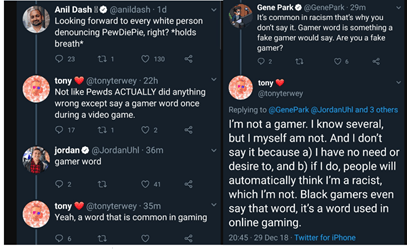
When a streamer (read: a professional video-game player) or a casual gamer drops the n-word while playing something online, it can be tempting for some to write this off as a thoughtless outburst during a heated gaming moment.” Colloquially, slurs are shrugged off and labeled as “Gamer Words,” (the n-word is widely regarded as the ‘worst’ of the Gamer Words) deploying a diluted euphemism to ward off charges of racist intent. The following Twitter exchange from 2018 demonstrates this tactic, and it is one of the earliest examples I could track down of “Gamer Word” being used in a public forum:

Racist slurs are not new, nor is invoking irrelevant context to excuse bad behavior. Men have dismissed accusations of misogynistic language as locker room talk or “boys being boys.” We have seen a similar playbook used in the sports world; the Washington Football Team was formerly named an anti-indigenous slur, and the Cleveland Indians used a racist logo for years (which you can read more about in my previous post, Misanthrope Mascot); they were rationalized in the name of “honoring” indigenous people.

When members of the gaming community pad these words with the comparable misnomers of “Gamer Language” and “Gamer Words,” they dishonestly deflect criticism around behavior that, in any other situation, would be categorized as hateful speech that comes from a deeper place of dangerous ideologies and destructive worldviews. These would not be dismissed, but rather they would be taken at face value as bigoted language.

Some of the highest-profile incidents involving the use of racial slurs in the gaming community involve Felix Arvid Ulf Kjellberg, better known as “PewDiePie,” as mentioned in the screencap above. If you noticed a resurgence of Minecraft and Minecraft-related content on YouTube this past year, PewDiePie was largely responsible for this uptick. Kjellberg has the second-most popular channel on YouTube with 107 million subscribers and posted many high-performing videos with that game as their focus. Like many rich and famous folks, Kjellberg has had his share of what Wikipedia labels “media controversies.” In January of 2017, when Kjellberg had a lowly 52 million subscriber-count, PewDiePie posted a video that included a clip of two performers dancing in front of a banner that read “DEATH TO ALL JEWS.” Kjellberg solicited this clip from the dancers on Fiverr and specifically requested that message be displayed, and Kjellberg paid these performers for that clip.

That video has since been made private. In his apology, Kjellberg said,

“I’m not antisemitic, or whatever it’s called, okay so don’t get the wrong idea. It was a funny meme, and I didn’t think it would work, okay. I swear I love Jews, I love ’em.”

In this tepid apology, there is no demonstrable understanding of race, antisemitism, or the history of death threats toward Jewish people and the destructive outcomes that have spawned from these words and beliefs. His motivations were unclear but spreading a message that advocates for the genocide of an entire ethnoreligious group in the name of “jokes” relinquishes the social responsibility that comes with a cultivating such a large online platform. There is already fertile ground for hate crimes in this world (the United States had a record high number of antisemitic incidents in 2019, including a deadly stabbing during a Hanukkah celebration in a New York suburb), and popular internet stars have an added responsibility with an increased audience. Their reach is far, and they have a social responsibility to act appropriately in public, especially when there is a potential impact that reflects on young audiences. After the white nationalist and Islamophobic Christchurch shooting left at least 49 Muslims dead, the shooter released a manifesto that included references to Fortnite and internet culture, including a call to “subscribe to PewDiePie.”  Kjellberg is not responsible for the mass shooting that happened in Christchurch, New Zealand, but it seems clear that the shooter has, at the very least, watched Kjellberg’s videos. At worst, the shooter identified in part with some hateful things PewDiePie has said in the past.

High-profile gamers continue to use this language seemingly without consequence, and this language becomes permissible among low-profile gamers in the general populace. According to a 2019 poll from Anti-Defamation League’s Center on Technology and Society, 65 percent of online gamers have experienced “severe harassment”, and “74 percent of online multiplayer gamers have experienced some form of harassment.” Unfortunately, PewDiePie’s controversies did not end with antisemitism; Kjellberg said the n-word while playing an online multiplayer shooter called PlayerUnknown’s Battlegrounds in September 2017. Kjellberg also posted and consequently deleted an image that mocked singer Demi Lovato’s drug addiction. Often times, like PewDiePie in his apologies, online harassers will hide behind the guise of making a joke or “doing it for the meme.” “Antisemitic, or whatever it’s called” or not, hate-speech-as-meme circulates regularly on the internet, which creates a self-reinforcing cycle of casual bigotry.

Hate speech and its consequences are not new in the United States – the New York Times Magazine’s 1619 Project gives a more comprehensive overview of anti-black racism’s history in this country – but it is an ever-shifting behemoth that finds new ways to be “acceptable” in popular culture and our society. Giving it the mask of “The Gamer Word” does just this – it codes the language and softens how we perceive its use. Calling it “The Gamer Word” also concedes that this is just a thing that happens in online spaces during video games and does nothing to challenge the norm. That norm, of course, should be challenged in the name of anti-racist pursuits. Racism is not the only form of bigotry found online; the GamerGate saga, for example, demonstrates the dangerous misogyny that is also alive and well within the gaming community. Racism, however, comes up time and again, and is unfortunately not a thing of the past.

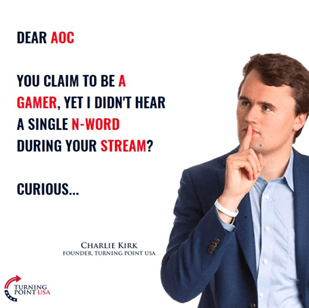
In October, Congresswoman Alexandria Ocasio-Cortez jumped on the streaming website Twitch to play the uber-popular multiplayer game called Among Us. Shortly after, someone I know sent the following meme to one of my group chats:

This joke relies on the common understanding that racist slurs are used regularly and openly in online gaming. Charlie Kirk serves as the punchline because he, like the tweeter defending PewDiePie, interprets the use of racial slurs as an in-group identifier rather than an expression of racial animosity. This is an argument that relies heavily on someone being “offended,” and it is an attempt to discount the “feelings” of someone on the receiving end of racist language.

The problem extends beyond simple offense-taking in Call of Duty lobbies or Reddit threads. According to Boston’s Childrens Hospital, “children targeted by racism have higher rates of depressionanxiety, and behavior problems and “when asked to recall a racist event they’d witnessed as a child, young adults had stress responses comparable to first responders after major disasters.” Around 20 percent of gamers are under 18; gamers and content creators are exposing children in their formative years to ideas that have been shown to inflict harm on their communities. I do not know if my pre-pubescent teammates understood the gravity of what they were saying during a Valorant match a few months ago, but it did not stop them from yelling the n-word back and forth in team chat. I am certain that they believed themselves to be “edgy” and found some sort of humor in using that word. I am also certain that they knew they should not be saying it, because one of them would only say the first half of the n-word, and the other would finish the other half. This has led to some of my friends instantly or automatically muting voice chat in various multiplayer first-person shooter games.

Without some sort of oversight or intervention, this is how society perpetuates and allows racism on an individual level. Riot Games, Blizzard and other large gaming studios claim they advocate against racism, but they fall short on effectively banning folks who use this kind of language, even they have more than enough resources to create a systematic solution for these bad actor individuals. The scope of systemic racism reaches far beyond an individual’s actions and racist behaviors, but it is a feedback loop. Without challenging these behaviors, the young and impressionable folks (like 11% of PewDiePie’s audience who are between 13 and 17 years old) who dole out these slurs become young adults who do not believe in systemic racism, nor do they believe that racism is a problem. This cycle keeps replacing the bricks that uphold racist and hateful foundations, and the damage continues to be wrought on vulnerable communities within that system.

Framing hateful speech as quotidian among gamers does real harm; the laughter of self-proclaimed “dark humorists” does not offset the damage of bigotry.

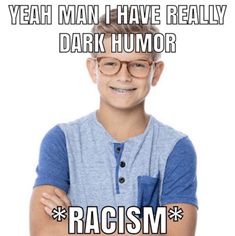
I hate to be the joke police, but I have developed a simple (and I believe very reasonable!) rule for jokes: jokes are supposed to be funny. I do not believe this is a high bar to clear for joke-tellers, content creators or recreational gamers. What, then, is funny about dancing in front of a sign that advocates for killing Jewish people? What is funny about drug addiction, specifically when a public figure is *publicly* sharing their fight against that disease? I may be called overly sensitive for these stances, but there are situations in which sensitivity is necessary for the health and safety of people who are vulnerable and/or part of marginalized communities. A friend of mine posted the following “meme” that I find more true than funny in one of our shared Discord servers (Discord, for the uninitiated, is like a fun version of Slack. There are different chat rooms and servers you can join to pop in and hang out with friends or game. It is a social medium designed specifically around gamers, but it has other uses as well.) I find this applicable to a not-insignificant portion of content I find online:

When a joke relies on hate speech as the punchline, it is lazy joke writing and harmful to folks not insulated by privileged identities. If you need examples of this, I will point you towards the MISFITS, a group of Australia-based content creators comprised of Australian and American YouTubers. Sometimes they are funny! Other times they come just short of saying the n-word or prod at an “n-word pass” or flat out say the slur for the giggles.

There is no reason to defend these words and this language, nor should we continue to accept them in our online spaces. Gamer Words need no protection nor are they under any threat; streamers with millions of subscribers live comfortably and have the privilege of entertaining audiences with video games. They need no defending. Marginalized and ostracized people targeted by this prejudiced and abusive language, however, deserve our fervent defense in the face of Gamer Words.

BURSTING THE BUBBLE

“Robert Emmerich – 2 PAN O2 World with NBA vs. Alba Berlin – Germany” by Robert Emmerich Photography 

The NBA, the coronavirus, and the decisions made along the way.

Dec. 30, 2020
by Corey P. Mueller

The NBA is back!

Normally, this would be cause for celebration in my household – I have a running fantasy basketball league in its 11th season, which is a constant source of trash-talking and sideline-analyzing for my brothers, my dad and me. The National Basketball Association is one of the threads that connects us, and draft night is essentially a holiday for us. It has its own traditions: my younger brother showing up right at draft time, my dad saying “aw, I was gonna take him!” once every three rounds and my older brother’s end-of-night Excel report.

I cannot celebrate the return of my favorite league this year, however (yes, I know, I’m an adult and this sounds ridiculous, but I love basketball like the player-formerly-known-as Metta World Peace loves basketball). COVID-19 has made many things miserable; it has caused too many deaths and a nosedive in the economy, and its ever-present anxiety inducement and frustration and risk and damage does not magically stop at the doors of NBA arenas. The NBA’s decision to start a new season amid the newest peak of the American pandemic is bewildering at my most generous read, and it is actively harmful at worst.

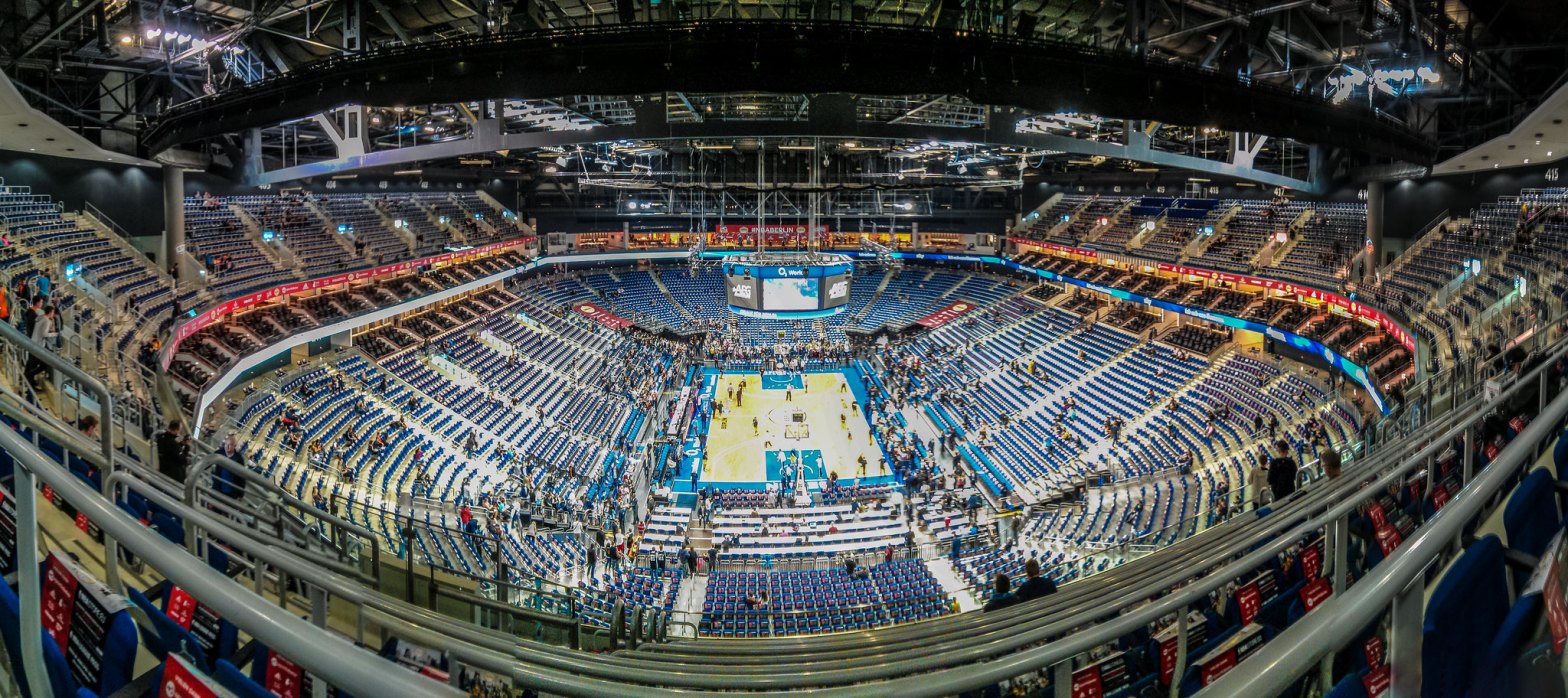
The NBA was the pioneer of American sports leagues in the pandemic; the NBA established a “bubble” with 22 of its 30 teams participating in an isolated league on Disney’s Orlando campus. Teams stayed in one of three designated hotels, played eight regular season games and a full set of playoff series.

These choices were made in a pinch – the NBA postponed its regular season on the night of March 11th but had approved a plan to restart the season by June 5th. That is 86 days. There were monetary incentives to complete the season, but the NBA buckled down and created a set of health and safety protocols in fewer than three months that would lead to the best example of “Stop the Spread” this country has seen. There was testing, there was testing, and there was testing. There were isolation protocols in case a player tested positive. There were limitations on visitors and travel; there were no guests allowed until the playoffs, and the league mandated a 10-day quarantine for players who left without its approval, or 4-day quarantine with league approval *and* a negative test every day that player was outside of the bubble. The NBA had set its course as the country was rapidly changing and shutting down.

On March 11th, I was sitting at a desk inside 30 Rockefeller Center, following the stats of the night on my phone while finishing a shift inside that 66-floor building. Tom Hanks tested positive for COVID-19 and started a quarantine over in Australia, but the virus didn’t feel *here* yet. When Rudy Gobert tested positive that same day, an entire sports league came to a screeching halt. A man who playfully touched a bunch of reporter microphones became patient zero in the NBA, and I remember thinking “oh, this is real now, and this is here.” Rudy Gobert’s downplaying of and subsequent contraction of the coronavirus had been a warning sign, and the NBA heeded!

The NBA, however, has scrapped its previous framework and gone back to a relative normal, save crowd sizes. The league had zero (0!) positive cases inside the bubble after players had settled in on campus. This time around, the league reported on December 2nd that 48 NBA players tested positive for COVID-19 during the first week of league testing for the 2020-21 season. I will concede that more teams are participating in this season than in the bubble, which leads to a greater probability that some players or staff would have contracted the virus.

What makes the start of this new season particularly frustrating is that National Basketball Players Association Executive Director Michele Roberts said the following in a late-July ESPN interview:

“If tomorrow looks like today, I don’t know how we say we can do it differently,” Roberts told ESPN in a phone interview Tuesday afternoon. “If tomorrow looks like today, and today we all acknowledge — and this is not Michele talking, this is the league, together with the PA and our respective experts saying, ‘This is the way to do it’ — then that’s going to have to be the way to do it.”

Has the coronavirus pandemic gotten better since that date? According to the NBA’s actions, it would suggest that it has. On July 22nd, the first day of exhibition games in the restart, there were 1,094 coronavirus deaths reported in the United States. This was part of the upward trend of coronavirus cases and daily deaths during the summer, which plateaued through August and into mid-September.

In the “tomorrow” land – specifically on December 23rd – the United States sets a single-day record with 3,350 reported deaths, according to NBC News. That same day, the Houston Rockets were unable to field a team and they postponed their first game of the new season. League rules state that a team needs 8 of its 15 rostered players in order to compete. The Rockets did not meet this requirement. Adam Silver’s lining is that his league has handled it relatively well compared to other leagues. The cruel reality is that 21-year-old Keyontae Johnson, a Division I NCAA athlete, collapsed on an American basketball court on December 12th. Johnson was hospitalized and briefly put into a medically induced coma. Afterwards, Johnson was diagnosed with acute myocarditis, which is a known cause of death in COVID-19 patients, just months after testing positive for the novel coronavirus. Keyontae Johnson survived but will not return to playing basketball this year. Johnson’s teammates continued and finished the game despite him being carried off in a stretcher, unresponsive to the first responders.

Other athletes have had to step in due to coronavirus-related absences, too. The Denver Broncos had to call on a practice team wide receiver when all four of its quarterbacks were out due to positive coronavirus cases and the NFL’s precautionary safety measures. The Baltimore Ravens had 22 players (over 40% of its roster!) out with the COVID-19 injury reserve designation, but still played 6 days after their originally scheduled game. There seems to be little concern with preventing the spread of the coronavirus until it’s too late.


The sports world is not alone in its struggle with this disease; the United States is failing to contain this novel disease that has taken at least 332,000 American lives at the time of writing this. The United States purports to be the world’s wealthiest and one of its most innovative country, and the US even ranks fourth in the World Index of Healthcare Innovation.

Yet, the United States continues to fail, seemingly never learning from the good or the bad measures taken either in the professional leagues or the communities in which we live.

In Roberts’ “tomorrow,” things have gotten much, much worse! Mind-bendingly, the NBPA only released a 57-word statement on November 6 approving a 72-game season and a start date of December 22, 2020. The teams would travel to their opponent’s respective cities, with Toronto as the only exception, and play a “regular” regular season. I can understand the hesitancy for adults with families (or young adults who would like to live their young, professional-athlete lifestyle!) to be locked away in isolation for an entire season, but the NBPA had nothing but rumors as to why they didn’t want a bubble. The league started much before the suggested dates in this Los Angeles Times article, which has NBA commissioner Adam Silver that he believed the 2021 season would start sometime in January of this year.

I understand a new bubble could be a logistical nightmare for the league – do we expand to two bubbles? Does that mean one is an Eastern Conference bubble in Orlando again and another Western Conference bubble is held in, I don’t know, Los Angeles or Chicago? They would need a minimum of three legitimate arenas, as demonstrated by the NBA’s first go of it, plus proper housing for these athletes and staff. These are logistics that the NBA figured out once.

The NBA, instead, abandoned its tried-and-true bubble method in lieu of a traveling, full season. James Harden is partying with his friends. John Wall is not the only one getting a haircut in this country, but he is one of the privileged few with access to rapid testing, contact tracing and proper quarantining resources. I don’t blame these individuals for doing these things – some are clearly irresponsible actions that I will not defend, but there are larger systems at play, too.

The NBA has done it right, they have the resources to do it, but they refuse to. This, I believe, is the core issue I take with the league. The NBA serves as an example of dangerous complacency. They could be showing us, again, this is how things *should* be done. Instead, they ask us to soothe ourselves with sports as entertainment, ignoring the all-too-real human cost. The NBA’s lack of regard for public health and safety is the same indifference and recklessness that has allowed this plague to spread unabated for the better part of a year.

I am incredibly disappointed in how the United States has handled the pandemic response, and basketball was a source of reprieve, especially in its response the first time around. I was holding out hope that the NBA could be the last beacon of light in this dark year. Yet, like all the Instagram stories of folks at weddings and parties and bars – and some eventual positive COVID test results – it has deteriorated my faith our ability to get through this without continuing the trend of excess, unnecessary suffering and death. I wanted the NBA to follow its own framework because, from a public health standpoint, they were nearly pristine! A few players broke protocol and were lucky to not test positive in the bubble, but the league kept its players, coaches and staff coronavirus-free from mid-July into mid-October. Unprecedented in this country.

The NBA is shirking its responsibility to its own players, coaches, and staff with its decision to carry out a dangerous, if lucrative, “regular” season. Recent broken protocol led to an opening-night cancellation for the Houston Rockets and Oklahoma City Thunder. Four Rockets will miss seven (7) days due to their isolation as a result of coronavirus contract tracing. Regardless, we got Christmas Day games! What the NBA is doing is putting a band-aid on the hull of a ship after a cannonball has ripped its way through, and, all the while, telling us to ignore that more cannonballs are coming.

The country is still in trouble, and the league is no different. It’s too late, and the wheel will continue to grind, but it is truly a shame that this is the version of basketball and society we get going into the new year.

I was hopeful the past year would bring about the right lessons, but it seems America (and the very American Basketball league, it turns out) refuses to learn.

Three-hundred thirty thousand Americans are dead, but 3,000 screaming fans will cheer on the Rockets at their next home game, blissfully insulated from the overflowing ICUs across the country, filled with people who would also, without a doubt, love to pretend that everything’s okay.

INTRODUCING MY BLOG

Welcome, dear reader, to the ramblings of a very-online man.

Hello! My name is Corey Mueller, I am an aspiring journalist currently working as a researcher in a massive television archive. I have some newfound free-time, so I thought I’d get back to writing and share it with you. I’m calling this “The Marching Ant” for the time being, name is subject to change!

What can you expect here? A lot!

I want to use this virtual space as a home for my thoughts about social issues, political happenings of the day, cultural issues in the United States, and much more.

I consider myself part of the newest generation of bloggers — I am on the cusp of Millennial and Generation Z, so I will be bringing a perspective informed by growing up in the early aughts (without a smart phone!) and coming to age during two financial crises. I have since spent an inordinate amount of time online.

I aim to post one (1) longform essay per week, focusing on whatever bothers or inspires me at that time. Additionally, I will write shorter posts for more pop culture-focused or quick-reaction pieces. I hope to bring thoughtful analysis to each topic about which I write.

Here are some things you can look forward to from me (and a lot of times, these will overlap):

  • BASKETBALL – I love the NBA, and I have spent a cumulative five (5) years working with an NCAA basketball team and an NBA youth program. It’s only natural that I want to talk about this sport!
  • POP CULTURE – I listen to a lot of music, I watch a bunch of television, I play a good amount of video games, and I dabble in films (who doesn’t? I have too many streaming subscriptions). I’ll do recaps and reviews, if that interests you!
  • SOCIAL ISSUES – I will try to tackle racial and gender politics as I understand them, focused on how various systems and identities interact and operate in the United States.
  • POLITICS – American politics have been part of my day-to-day life for the last six (6) years, and I am concerned about the state of this nation as it stands today. I think there is a lot of work to be done to get us going in the right direction, and I hope to give thoughtful analysis and helpful suggestions as I can.

That’s about it for me! Thanks for reading, if you have. I look forward to writing more, for me and for you. Here we go!

MISANTHROPE MASCOT

“The ‘Other’ Cleveland Team” by Imagine24 

FROM THE ARCHIVES: Cleveland’s real “mistake on the lake” is an atrocious continuation of a racist logo.

Feb. 09, 2017
by Corey P. Mueller

Cuyahoga. It means “crooked river” in original Iroquoian tongue.  That is the name given to both the most populous county in Ohio — home to the city of Cleveland — and the winding river that curves through the center of the county. It was a name meant to honor the indigenous people who lived off this river, the very river that the white people of Cleveland have since disrespected and polluted to the point of roaring flames in the mid-20th century.

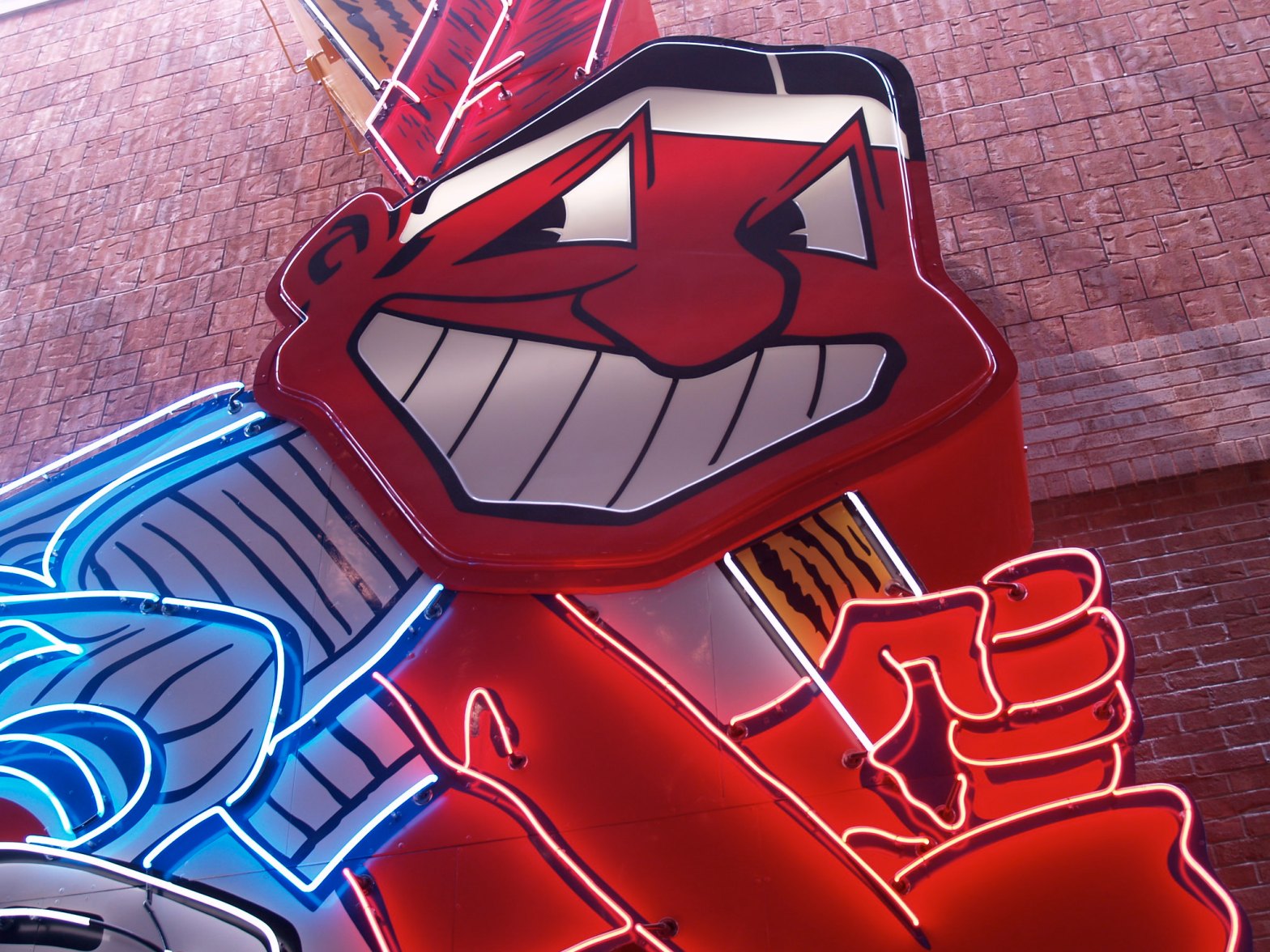
Though the river has been cleaned up, another atrocity with a native name remains in the city.  A large-nosed, red-faced, wide-grinning caricature of indigenous people still finds its home on the sleeves and ball caps of the professional baseball organization, the Cleveland Indians.

Chief Wahoo is his name, and outdated racial stereotypes are his game.  Reminiscent of Tonto or any nameless antagonist to John Wayne, Chief Wahoo stares blankly into the void of white baseball fans with an ear-to-ear smile. In another attempt to “honor” those that inhabited the land before the urban area and surrounding suburbs developed, Cleveland again disrespects the names and real populations of Native Americans that exist in the United States. The continued use of stereotypes in this caricature has real world consequences. But the people of Cleveland seem not to care.

In an anonymous Twitter survey I ran, my followers (composed of mostly middle-class, suburban white people) were three and a half times more likely to vote for “#KeepTheChief” than the “Get rid of Chief Wahoo!” option. Perhaps the voters were empowered by the catchy hashtag, or they were enticed by a more sinister power given to them in perpetuating racist stereotypes with a single image. Whatever the reason, few #KeepTheChief voters came forward to explain their position.

“It’s clear that she’s never met a native, never been to a reservation. To her, natives are invisible. If they weren’t, she wouldn’t even think of wearing that.”

In fact, only one did. He was the sole voice for the majority opinion, and he said he will, in all caps, “FOREVER ROCK THE CHIEF.” When questioned with a simple “why” the 21-year-old Indians fan responded with, “It’s part of me.” Pointing to tradition and something that he grew up with, it is a sentiment that is heard over and over again within Cleveland baseball circles.

“I get it, you want to feel like you’re seven years old again going to the ballpark with your dad.” David Takehara, whose mother is full-blooded Sioux Indian, does not buy that argument. Takehara’s mother hails from the Sisseton Wahpeton Oyate tribe in South Dakota, but David grew up in Chicago. He described a recent experience watching his hometown Chicago Cubs play against the Cleveland baseball organization in the World Series. He recalls a crowd shot focusing on a young woman, a Cleveland fan. She wore a giant Chief Wahoo on her shirt, and he shook his head at the sight.  “It’s clear that she’s never met a native, never been to a reservation. To her, natives are invisible. If they weren’t, she wouldn’t even think of wearing that.”

Takehara invokes the Contact Hypothesis here: The more people of color one meets, the less likely he or she is to be biased or derogatory to those people. This is a contested theory, but, according to Vincent Romero, we do know one thing: “Using this mascot perpetuates a historical, comical and insulting caricature, and it is perpetuating stereotypes that are long gone.” Romero, the Executive Director of the American Indian Center Chicago, says these stereotypes only live on because of mascots like Chief Wahoo. Native Americans are not bow-wielding, horse-riding savages, yet this is the only image many Americans have of this diverse group of people that exist off of reservations and outside of the 19th century Wild West.  Yet, this is an image of which many refuse to let go.

There is not just a conflict of images here, though. There is a personal conflict that inflicts actual damage on historically damaged communities. “It’s not just about being politically correct,” Romero stated. “This gravely affects the self-esteem and pride of Native youth, and they’ll grow up becoming ashamed of their culture, of who we are.” Native kids across this country find themselves as the target of harassment, ridicule and violence when they speak up, often when they simply state, “Hey, that is racism.”

“You feel like you’re not good enough to be a regular American,” Takehara said grimly. “You’re not even visible.” Though Takehara was born and raised on the north side of Chicago, he still experienced dismissiveness of his Native roots. Teachers refused to believe he was Native American because of half the genes he inherited from his Japanese-American father.

It does not matter if your home, as a Native person, is on a reservation.  Everything and everyone constantly puts you down, Takehara tells me. Using a mascot like Chief Wahoo continues a longstanding attitude of “They don’t exist, they don’t matter.”

This is just one type of historical trauma imposed upon indigenous populations of this country.  Another comes at the turn of the 20th century.  It was a policy of the federal government to “Kill the Indian, save the man.”  Erik Stegman, the quick-talking Executive Director at the Center for Native American Youth at the Aspen Institute, expands upon this through an examination of the American Indian boarding school system. “They forcibly took kids away from their families and tribal communities, put them in boarding schools where they were beaten for speaking their language. They were forced to assimilate, and they were horrible places.”  Native youth in the past, like Takehara’s mother, have been traumatized at these types of places with physical and mental abuse.

Some of these abuses, for example, come in the form of caricatures and stereotypes of what not to be. During her stay at an American Indian boarding school, Takehara’s mother was taught and tortured to be ashamed of her culture and heritage. There is an intergenerational trauma that cycles through this: Where parents and grandparents in the past were shown racist imagery to shame them for their history, youth today are bullied, targeted and again stripped of their culture through ahistorical representations of mascots in schools and in professional sports.

“Mascots become a reference point for bullying,” Stegman explained. “They’re a tool for abuse, especially when non-Native people use them.” This creates a hostile learning environment that contributes to mental health issues, creating a large hurdle for progress in Native communities. Natives commit suicide nearly two and a half times the national average rate, which makes suicide the second leading cause of death for Natives between the ages of 15 and 35.

A mental health crisis, paired with a poverty rate double that of the national average, plagues Native populations. And the continued use of a Chief Wahoo shows that non-Native people do not really care all that much. Further, they still demand that the Native people bootstrap their way out of it.  “It makes it tough to do what people ask you to do,” Takehara said with an inkling of pain in the back of his throat. “Reservations have less jobs, less opportunities. But how do you get out of that if you have a reduced self-esteem?” Though some may scoff at the idea of this, decreased self-esteem drastically and negatively impacts people’s performances in and out of the classroom. It sets them up to fail before they can even try to succeed.

To start to combat this antagonistic imposition, MLB organizations need to denounce and eliminate the use of mascots like Chief Wahoo, as painful as that may be to the white fan base in Cleveland.  Overwhelmingly, the response from the Native communities has been that the organization must discontinue the mascot and disavow its use as a culturally insensitive and stereotypical abomination. Chief Wahoo’s discontinuation would send a powerful message that the Cleveland baseball organization is starting to listen, but that is only a start. “They have to have an open, honest dialogue with local and national native groups,” Romero iterated and reiterated to me, with more pressing concern on each utterance of this important sentiment. “The leadership in the front office needs to set an example for the rest.”

Ultimately, the team needs to make sure the concerns of Native peoples and activists are heard and that they respectfully engage with this issue. Currently, the organization releases shrouded statements that the team will “phase out” the use of the Chief, yet continue to use him on nearly all of their jerseys.

One of the worst defenses of the use of a mascot like Wahoo, according to Stegman, is people claiming that they are “somehow honoring native people,” without respectfully appreciating the culture and acknowledging the history of Native peoples in this country. “When you can’t even point to what supposed tribe this representation is from,” Stegman briefly laughs at the absurdity of his own thought, “how exactly can a non-native person say that they’re honoring anything?”